Tuesday, March 20, 2012

Floyd Smith the St. Louis Club Plantation and the first electric guitar solo.


Where did the idea of putting an electric guitar solo in a song come from?

The St. Louis Club Plantation.

And Floyd Smith.

Benny Goodman wanted him, Charlie Christian was his friend, and he met and jammed with Django Reinhardt. So why doesn’t everybody know St. Louis music legend Floyd Smith?

I first found out about Floyd Smith while interviewing St. Louisan and star of Earl Hines' orchestra, LeRoy Harris. As young boys, Harris and Smith played ukuleles for tips in saloons. Harris would eventually join Earl Hines’ Orchestra and Smith worked in the bands of the St Louis Crackerjacks and the Jeter-Pillars Orchestra. It was while performing at the St. Louis Club Plantation, that Smith began featuring his electric guitar work in the jazz dance band. The Jeter-Pillars’ theme song, Lazy Rhythm, was recorded in the late 1930s and it turned out to be one of those milestone events in American music history, for the tune has the honor of being the first electric guitar solo on a recording. No one could have known at the time, but soon music was going to change from swing orchestras to smaller combos and the guitar would replace the trumpet as the star of the bandstand. And the electric guitar solo would become the aria of the rock and roll genre for a couple of generations.

The sound of St. Louis’ favorite band in the city’s most popular nightclub in 1937 is documented on an Okeh Recording Company 78 rpm record. The Jeter-Pillars Club Plantation Orchestra performs Lazy Rhythm and I Like Pie I Like Cake. This is the first electric guitar solo. The guitar revolution in popular music was still a decade away. And ironically, Chuck Berry lived right down the street, but was well younger than sweet little sixteen at the time.

No one really made a big deal of the pop-culturally seismic event at the time, or how Floyd Smith’s guitar would cause music to change. And this wasn’t merely a fluke either because a couple of years later when Smith was recording with Andy Kirk and His Twelve Clouds of Joy he waxed another historic milestone, Floyd’s Guitar Blues - the very first electric guitar instrumental recording.

Smith went on with the rest of his career while the guitar heroes that came after him took the glory. You'd think that inventing the amplified guitar solo would get a mention in one of the hundreds of those music Halls of Fame and museum-things, but apparently it's not.

Then in 1979, a Guitar Player magazine article about early guitar legends rightfully mentioned Smith’s name, but none of his achievements. Retired in Indianapolis at the time, he felt compelled to correct the inaccuracies in a letter to the editor. Smith seemed proud to say that he taught himself the ukulele and banjo as a young man, but he was modest about his groundbreaking recording of Lazy Rhythm, “I used octaves in my solo. That was the first amplified solo." And for the guitar fans he added that it was done on a Rickenbacker guitar.

"In the Jeter-Pillars band I learned the Hawaiian guitar on which I recorded ‘Floyd's Guitar Blues’ in 1939" he wrote.

He signed the letter proudly with his Musicians Union credentials, "Floyd Smith, St. Louis MO. Life Member, 10-208 Chicago and Local #3 here in Indy."

Certainly the credit for bringing the electric guitar to reign over pop

music belongs to a group of artists like Christian and Berry and others and it's silly to think that individuals can change the course of culture by themselves, but Floyd Smith has never gotten the credit he deserves for his contributions to American music.

And neither did his hometown.

And now the building where he changed music will soon be torn down.

Tuesday, January 17, 2012

The St. Louis Palladium.

This is very cool! Famous St Louis architectural photographer Peter Wilson came along one day to the Palladium building and set up a tripod for a couple of shots while we talked about the history and the Club Plantation. He was so casual about what he was doing, that I suspected that he was just snapping reference shots. Then last week he sent me this -


Wow. What a beautiful shot!
This isn't what I saw that day. When I was standing on the sidewalk across from the building, I could find no other view of the structure other than a straightforward composition. Also, it was getting dark early and I assumed there wouldn't be much light to work with. So I am very impressed. Wilson's image really creates an exciting scenery out of the blank shuttered building. No trick floodlights, the photograph shows the natural condition of the building. And in his artwork I can see the antique elegance of the old building - something I now know that Wilson was capturing, but I didn't see while standing in the cold late afternoon on Delmar.
Mr. Wilson's website is here: peterwilsonphotography.com

And this is cool too! Andrew Torch is a fellow artist and proprietor of Andy's Toys. He mentioned to me one day that he had a poster of a montage of St Louis-related ephemera that showed tickets to the St. Louis Palladium Roller Skating Rink. So I rushed over and got a couple of pictures of them.

Looks to me like it's from the 1930s.
Thanks Andy! Go see his store at 9620 Gravois in St. Louis, it's got all the cool stuff your mom threw away when you went away to school.

Thursday, September 29, 2011

The St Louis St Paul.

The book, Devil At The Confluence, concerns the incredible stories of over a hundred important musicians from St. Louis who had never been profiled before. Although these musicians were neglected in music history they represent important claims of St. Louis contributions to American culture. And like the recorded blues of St. Louis, the local foods have never really been investigated either. There are the famous local inventions of Iced Tea, Ice Cream, Toasted Ravioli and Gooey Butter Cake, but this essay is an attempt to end speculation with facts concerning the rarely honored St. Paul sandwich. Because just like St. Louis music, other historically important cultural inventions from St Louis have been neglected and ignored for too long.

These new facts about the St. Paul were stumbled upon while researching for the book. It’s bothersome that many St. Louis historical facts and artifacts have been appropriated by other areas and even more bothersome that it seems that the facts were conceded without argument. Some of these claims may seem unimportant such as the creation of Planters Punch or the Tom Collins cocktails, while others are nationally significant cultural traditions such as beer and hotdogs at baseball games. And somewhere in that wide span of cultural importance falls the St. Paul sandwich.


Wiki (and please, kids never, ever confuse Wikis for real research) states that:

The St. Paul Sandwich is a type of sandwich found in Chinese restaurants in St. Louis. The sandwich consists of an egg foo young patty served with lettuce, pickle slices, mayonnaise and tomatoes between two slices of soft commercial white bread, such as Wonder Bread.”

But Wiki is not the place to look for missing answers to unsolved mysteries. The crowd-sourced and unverified soft-database says:

The origin of the sandwich is unclear

followed by this Wiki-wishy-washiness:

It was invented in St. Louis, Missouri and is usually only available in Chinese restaurants in the St. Louis metropolitan area.


The St. Louis St. Paul sandwich was featured in a 2002 PBS documentary called Sandwiches That You Will Like but the question of the history of the item was answered with a shrug. In the companion book of the documentary, American Sandwich: Great Eats From All 50 States.” it says that sources (unnamed) claim that the sandwich dates as far back as the 1960s and another source (unnamed) says the early 1940s.


So no one knows the history about the sandwich, yet the sandwich can only be found in St. Louis? Well that’s enough to claim it as a local invention. Really, if this was Chicago that would be enough and it would be up to somebody else to try and prove that it wasn’t. In fact, that’s the way it is for nearly every historical claim to American foods like hot dogs, pizza or pretzels. There just isn’t a lot of documentation on this kinda stuff, so being the only place that has it means it comes from there. This shouldn’t be a mystery.

Or could it be that St. Louis doesn’t want to claim it? Like the gooey butter and fried brains crowd draws a line in the saturated fat and refuses the St. Paul? Or maybe it’s like St. Louis’ unclaimed rights to American music history, a victim of that local inferiority-complex thing - a belief that new or important creativity must have come from somewhere else.

Or maybe it’s not as bad as all that. In the last few years there seems to be a change for the better in St. Louis. There is a new local pride. And the St. Paul sandwich has benefited from it.

In 2009, after Playboy magazine listed the St. Paul Sandwich as one of its top ten sandwiches, but noted that the sandwich might not have St. Louis roots, Joe Bonwich defended the city’s claim in his comments in STLToday:

This is a one-source legend dating to a 2006 article by Malcom Gay in the RFT, in which Park Chop Suey's owner claims that a former owner of the restaurant, who was from St. Paul, Minn., invented the thing. But there's no corroborating evidence, and the way it's worded, it sounds like the sandwich was invented in St. Paul and migrated here.

Thank you, Mr Bonwich!


Alone, the sandwich may not be as big of a tourism draw as perhaps the Cheesesteak is for Philly, but maybe it can be. Lunch Encounter, a blog by Washington, DC-based food writer Lisa Cherkasky apparently thinks so:

Just one more compelling reason to get your sandwich eating self to St Louis, the St Paul Sandwich.

Thank you Lisa, bring them in. And then she muses about the source of the dish by showing some impressive knowledge of local history:

I wonder, does it have anything to do with Chinese railroad workers? I would say, after doing a tiny bit of research, yes. In 2007 there were 700 Chinese restaurants in St Louis. That would point, one would reason, to a long history of Chinese-American culture. When you sit in Busch Stadium watching St. Louis Cardinals games, you may never imagine this location was once China Town. The first wave of Chinese came to St. Louis in 1869 when many of them lost their jobs as railroad construction workers. At the peak period, the Mid-Pacific Railroad Company hired over 10,000 Chinese laborers. When the westward railroad construction was completed, many became unemployed. Many of them chose to come to St. Louis that was then the 4th largest city in the United States.

St Louis' Chinatown was without firm and clear borders just like the many other immigrant areas of the city. The area of Busch Stadium at that same time was also known as Tamaletown, with a large number of Mexican immigrants. In Devil At The Confluence there is an early picture of the headquarters of African-American music, the Deluxe Music Shop and visible next door to it is Wo Hop Chop Suey. Different nationalities and races mixed block-by-block in the city at the turn of the century. And that fact about the confluence city is perhaps most significant to the cultural invention of the St Paul sandwich as noted by none other than frontman for the local alt-country/roots rock band, the Bottle Rockets, Brian Henneman.

I wouldn't be one bit surprised to find out the St. Paul sandwich originated from the cross pollination of African American culture, and the plethora of local Chinese restaurants.

And there it is. There is the significant uniqueness of St Louis' cultural history - the merging of styles in a location suited for the creative blending. A common ground that isn't north or south, or east or west, or country or urban. There's a strand of the unifiying thread found across the cultural and creative aspects of the city of the confluence.


So here we add the evidence found during our research. The first image is a photograph from sometime around the turn of the century. Two men stand in front of a typical restaurant on a street in St. Louis, on the wall is posted the menu.

The second image shows the wall menu in the photograph enlarged and enhanced. The second item in the SANDWICHES column on the left reads: “Try our ST. PAUL


The next images are St. Louis Post-Dispatch newspaper articles. From 1922, the Man On The Sandbox editorial column reads: “Our idea of a civic short order lunch is a St. Paul sandwich on Milwaukee rye.”


From 1918, the Sport Salad column makes reference to a St. Paul sandwich, “which is composed principally of ham and eggs.”


Both of these St. Louis editorials are making esoteric comments on matters of the day that are not known so it’s hard to understand what exactly these comments mean, but they are surely joking about something.

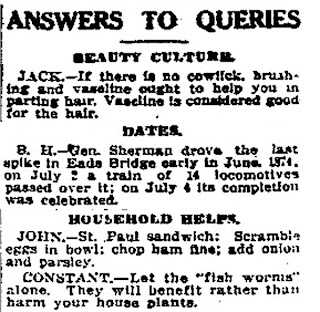
And from a 1916 column replying with answers to unprinted reader’s questions, “John” is told the ingredients for a “St. Paul sandwich: Scramble eggs in a bowl; chop ham fine; add onion and parsley.”
It was at the 1904 Worlds Fair in St. Louis that so many exhibitions tried very hard to show off new inventions and recipes and at least four versions of the Club Sandwich appeared there. This might have been the debut of the American sandwich formula of “meat + Mayonnaise + lettuce + tomato.”

So the history of the St. Paul sandwich has been an established St. Louis restaurant item now for at least one hundred years. It seems very likely that the various Asian, African and European immigrants in the densely populated city was the unique combination of factors that contributed to the creation of the Americanized Egg Foo Yung sandwich with the Catholic name - the Saint Louis Saint Paul.

Wednesday, September 14, 2011

A beautiful coffee-table book with original illustrations, vintage advertising and rare photographs detailing the chronological story of what the St. Louis blues are, who the St. Louis blues musicians were, and how their careers began in St. Louis.
Included with the book is a special compact disc of recordings by St Louis legends from Delmark Records. Devil At The Confluence is the only comprehensive book ever published on the history of the blues music of St. Louis.

Devil At The Confluence, The PreWar Blues Of St. Louis, Missouri is available at the St. Louis independent bookstores
Left Bank Books (Central West End and Downtown),
The Illustrated Art Museum in Crestwood Artspace,
Subterranean Books (University City),
The Archive on Cherokee Street,

Information and news is also posted on Facebook. Be a friend of the Devil:

Wednesday, August 17, 2011

The Palladium and the Marathon craze


A marathon dance in 1910 in St Louis ended when it was called a draw and three prizes were awarded to three couples. As organizer of the benefit, Annie Jackson made the call. She was worried that the police would interfere if the marathon became too strenuous on the couples. Already that summer, marathons had been raided by police in San Francisco and Brooklyn and Annie didn't want any such trouble at her event. Also, the public attendance for the week had been exceptional so she could easily afford to pay each couple the $25 prize. That wasn't how the marathon dances craze of the later Jazz Age usually went. Typically, these things were 24/7, no-mercy, last-man-standing kind of endurance contests. The same themes of reality TV like Survivor, Idol and Dancing with the Stars, the dance marathon was the beginning of the stuff of American pop culture. Horace McCoy's book, They Shoot Horses, Don't They? was made into a movie in the 1970s and it portrays the character, the hype and the seedy scenes of the marathon spectacle very vividly.

The Palladium building off Grand at Delmar and Enright was built as a Roller Skating rink in 1914 and a newspaper article told of Gene Rodemich's early St Louis Jazz band performing there. Music was changing from the Ragtime fad to the Jazz fad and the spectator sport of Roller Derby was evolving around the Rollerskating fad. On these roller skating rinks, the Marathon Dance Derby or "Walkathon" fad began.


Reliable information available about the Marathon craze is scarce and most of what is available assumes that it occurred only during the depression. But it was in at least two other cities besides St. Louis by 1910 and the last one in St. Louis was held at the end of the 1930s.

By 1950, the Club Plantation had seen it's best days. The club's old crowd had settled down to make baby-boom babies and didn't come out much anymore. The new younger crowd with their new music were making some new place crowded, like the beatniks over in the Gaslight Square area or the lounge crooners at the Chase Hotel.

Historically, St. Louis culture has a unique creative technique in finding the future trends - it takes the best of the past and brings it forward. So it doesn't seem strange that the Club Plantation's owner, Tony Scarpelli, had an idea to bring back some business to his place by bringing back the Marathon. He ran an ad in the entertainment trade journals for a revival of an authentic old-time Walkathon Derby in the authentic, historic Palladium building.


It's not known if his Walkathon revival ever happened. Shortly thereafter the Club Plantation was gone and Tony had gone into other business. But maybe years later, he saw the movie They Shoot Horses, Don't They?

And maybe years later, Tony saw the end of the 1970s when the younger crowd and their new music called Disco were dancing on Rollerskates in Roller Rinks.

Tuesday, July 19, 2011

More History of The Palladium / St Louis Club Plantation

This post continues with the history of the Palladium Building/Club Plantation, and reveals the ownership and managers behind the famous St Louis nightclub. Like the stories and musicians in the book,

Devil At The Confluence, this information has never been published before. Currently, the Palladium building may be sold and demolished like so many other lost historic landmarks, so this series of stories are being gathered and posted as quickly as possible so the important history of this legendary nightspot is available while the structure still stands. The inadequate historical record and disinterest for preservation of cultural landmarks by the alderman and governance of the city of St Louis does not reflect the pride that the citizens have of their city. But there is a new attitude of appreciation and preservation in the citizenry and it outnumbers the old. Even though the current office holders do not reflect that yet.


Al Capone may be one of America's most well-known gangsters and a symbol of lawlessness in Chicago, yet his crimes are proudly exhibited in Chicago's History Museum. There is no museum in St. Louis for the prohibition era gangsters of the city. While that may be due to, well let's just say, an overly-sensitive inhibition concerning all facets of its history, the true fact why the Mob bosses in the Lou aren't well known is a testament to how much better they were than Capone. Afterall, surely the main job of a good Mob boss is to keep everyone in the city from knowing you're the Mob boss.


The St. Louis gangster, Tony Scarpelli owned the Club Plantation. The club operated as a set-ups nightclub, meaning they sold food and provided ice, soft drinks, and glasses and the customers brought their own liquor. This way they could stay open later than the 1 o'clock curfew for taverns. A liquor law work-around.


St. Louis has a long-held distaste for liquor laws. First, because beer and wine are a part of the traditions and culture for the St Louis German, Irish and Italian immigrants, and second, because of the great brewing industry that employed many of the citizens. There's also a long tradition of organized crime in St. Louis as well, including mobsters Dinty Colbeck and Buster Wortman, whose careers were also principally, well let's just say, in the liquor and spirits trade. So St Louis had Jazz Age prohibition entertainment and nightlife as vibrant as Chicago, Los Angeles or Las Vegas, and they also had the same kind of prohibition trouble.


But the Club Plantation's Tony Scarpelli was, it appears, nothing more than a minor hood with only minor liquor law violations on his record. But dig a bit deeper and you might find that his rap sheet included armed robbery and a file with the FBI. Most of the people in the city probably didn't know about that. Sure, there was talk around but that was just rumor. Now Tony's younger brother Jimmy's rap sheet included bootlegging, robbery, gambling and a murder charge, so his involvement with the nightclub was kept on the QT. There was a lot about the Club Plantation that was on the QT. So maybe Tony was just good at, well let's just say, keeping his nose clean.

Tuesday, June 28, 2011

More history of the Palladium Building, St Louis, Missouri


The book, Devil At The Confluence, proves that St. Louis was a more important center for American music than has traditionally been thought. One of the reasons that history disregards St. Louis' influence is because the many stories about the city had not been preserved or celebrated. Likewise, the stories and the importance of the historic Club Plantation has nearly been forgotten as well, and the building is now in danger of being demolished. Since the purpose of creating the book was an effort to establish the stories before they were lost forever, it feels like a responsibility now to post the stories of the Club Plantation for the same reasons.

This story is a great example of St Louis' influence and inspiration to American cultural history. Traditional music history has long assumed that the Mississippi river was responsible for the city's reputation as a cultural center, but it's the people and the local culture - not the river, roads or train tracks that make St. Louis a great city.

In 1946, songwriter Bobby Troup left Pennslyvania on a road trip on US Highway 40 to come to the St. Louis Club Plantation where Louis Armstrong was performing to a SRO sellout crowd. Traveling with his wife, he planned his roadtrip to eventually get to Los Angeles. Enthused partly about the new post-War freedom of auto and cross-country travel and partly to get to St. Louie to see the great Satchmo, Troup was inspired enroute to write the song he is most famous for: "(Get Your Kicks On) Route 66."

Next: Stories of the gangsters who were behind the historic Club Plantation.