Wednesday, September 19, 2012

The Missouri State Archives program on the history of pre-World War II St. Louis blues music.


http://www.stlamerican.com/news/local_news/article_7a9a5a84-f06a-11e1-9be5-001a4bcf887a.html
Carnahan announces program on the history of the pre-war blues music of St. Louis
Posted: Monday, August 27, 2012 12:27 pm
Special to The American 
Jefferson City, Mo. – Missouri Secretary of State Robin Carnahan today announced a program on the history of pre-World War II St. Louis blues music. The program will be held at the Missouri State Archives, a division of her office, on Thursday, August 30, 2012, at 7:00 p.m. Artist and historian Kevin Belford will be discussing his new book, Devil At The Confluence: The Pre-War Blues Music of St. Louis.

Devil At The Confluence is the first comprehensive book ever published on the history of St. Louis blues music. It tells the fascinating story of the profound connection between St. Louis bluesmen and their city.   Kevin Belford uses original illustrations, vintage advertising and rare photographs to detail the chronology of blues music in St. Louis. For Belford, what originally began as a desire to paint a portrait series on St. Louis blues artists ultimately turned into a 15-year historical inquiry. After combing through census records and other public documents, Belford pieced together musical profiles of many of the forgotten St. Louis-based blues recording artists from the 1920s and 1930s.

Belford reveals the untold history of the St. Louis blues movement and its contributions to American popular music. Show More Show Less
The Missouri State Archives is the official repository for state documents of permanent historic value and is located at 600 West Main Street in Jefferson City. All programs at the Archives are free of charge and open to the public, with seating available on a first-come, first-served basis.


I arrived hours early to do some searching and I was amazed. The Archive library is a pleasure to do research in. The staff is exceptionally helpful and the databases are swift and easy to search through. What an amazing state-of-the-art  facility. If you can't visit, Secretary Of State Robin Carnahan has done a terrific job to get the records available on the website: http://www.sos.mo.gov/archives/
This repository is a fine model of helpfulness and access that hopefully other archives will emulate.

The lecture went over very well. The audience was very interested in the stories of St Louis blues. It was a really great crowd in our state's Capitol city, and they genuinely share our pride in our historical legacy. We recieved a very nice compliment from Stephen Siwinski on the Facebook page: "Hands down the most entertaining and informative presentation to grace the James C. Kirkpatrick State Information Center. Big thanks to Kevin for painting such a vivid picture of pre-war blues in St. Louis." Thanks, Steve. If we ever get T-shirts made, we'll send you one.

Saturday, August 4, 2012

The effort to save the Historic St. Louis Palladium / Club Plantation building gains momentum.


There have been a lot of postings to the Save-The-Palladium-Building-At-Grand-Center Facebook group -
https://www.facebook.com/pages/Save-The-Palladium-Building-at-Grand-Center/198466843570157
and they should be posted here as well, so here they are in random order:


Stride piano player Buck Washington and the legendary rhythm tap dancer John Bubbles Sublett performed with Brooklyn, Illinois' George Hudson in 1944 at the St Louis Club Plantation as announced by this clipping from Billboard magazine.


More graphics donated to the preservation effort.

There was a strange news report made by the John Cochran VA Medical Center with the misleading title, "Sweetie Pie's offered buyout for VA expansion." Strange, because the VA is not trying to buy Sweetie Pie's, nor do they say they want it, nor do they admit to anything. "Associate Medical Director" Keith Repko, having called the TV station out to interview him, does not discuss his scheme, nor any expansion options such as the surrounding lots, North, East and West, and he makes no acknowledgement of the bigger property next door, the 100 year old Palladium building.
Either they want to scare the new employees of Sweetie Pie's or our Veteran's Administration is playing around to create a false dilemma of which building, the new one or the old one, should be razed.

Could VA Hospital Expansion Force Sweetie Pies Upper Crust Out?
ST. LOUIS, MO (KTVI) – An expansion is planned for the John Cochran VA Medical Center, but it could affect...
http://fox2now.com/2012/07/10/sweetie-pies-offered-buyout-for-va-expansion/


The Five Red Caps appearing at the St Louis Club Plantation in the Forties playing their hits: Mama Put Your Britches On, Sugar Lips, Mary Had A Little Jam, Boogie Woogie On A Saturday Night, and It's Got A Hole In It.


There will be more to come as the effort gains support. Please spread the word and like the Facebok page! Thank you.

Monday, April 16, 2012

The Lost Interview

Kevin Belford on “Devil at the Confluence”
By Dana Smith from (the now defunct) Creative Saint Louis, from 06/21/10.

Recently I caught up with Kevin Belford and asked him a few questions about his fascinating book, “Devil at the Confluence”.

Your book could be called a crucial missing piece of the Saint Louis music puzzle. Any guesses why it’s been missing for so long?
From the start I found that the understanding of American blues music has, by definition, disregarded Saint Louis’ artists. In the scholarly definition, the blues are regressive music from southern isolated areas. Scholars and musicologists overlooked the blues music from here because the city is not southern and the music was too creative, progressive and too influential to be included in their limited definition of blues.

But, actually, blues music was one of the first widely-popular American music forms along with marching bands, ragtime and jazz. “Devil At The Confluence" contains the names of hundreds of national stars and superstars from Saint Louis in the pre-war period when march music became ragtime and developed into jazz and blues and later those evolved into rock and roll. Most of these Saint Louis artists have no biography or mention in pfrevious blues literature. They were virtually forgotten even though their records were some of the best selling songs in the 1920s and ’30s. But they weren’t from the Delta and they weren’t rustic, old-fashioned songs like what those later blues researchers were looking for.

I think Saint Louisans know this about the local music in our lifetimes as well. The arts of the Confluence city have always been a creative merging of styles and taking the best of what came before to create the new. A legacy from the turn of the century of great music in all fashions that continues to this day and is enjoyed every night in the city – whether the music industry, the press or academia outside of the area appreciate it or not.

Professionally you’re an artist and illustrator and the book features many interesting images created by you but how did you end up writing the book as well? Some of the images will be on display at the Royale, which ones?
Commemorating the Saint Louis legends with my artwork was what I had set out to do. Finding that there is a lack of published information about the city’s artists and the realization of the importance of the information that I found, compelled me to make the book. So the art and design was really only about a tenth of the time that went into this project.

Also, I realized that what I found to be true of the music history of Saint Louis is also true of the rest of the arts of the city. Credit is lacking for much of the city’s cultural progress in so many great aspects like theatre, poetry and literature, dance, architecture and much more. Hopefully this effort will prompt those investigations.

After reading the book, you get a clearer picture of all the important musicians and singers who were vital to the development of not only the Blues but also Ragtime and even Jazz who were creating music in Saint Louis. Can you mention some of these forgotten artists who made critical contributions to Popular Music?
The superstar artists from Saint Louis like Lonnie Johnson, Big Joe Williams, Victoria Spivey and Walter Davis are often listed in the old books on the blues as being from the Delta, Texas or Mississippi when in fact, they all lived and recorded in St Louis and each had family here. There are nearly 200 names of Saint Louis artists in “Devil At The Confluence” and perhaps half or more have made significant contributions to the blues and American music. From the songs, “Frankie and Johnny” and “Staggerlee” to the genesis of songs like “Everyday I Have The Blues” by Aaron Sparks, and “Mr. Carl’s Blues (Dust My Broom)” by Carl Rafferty, St Louis’ artists have contributed some of the most well-known and important aspects of the genre and most of the music authorities never realized or acknowledged this. Yet.

You’ve spent a lot of time on this book and now it’s out and getting a good response. Any new books or projects in the works?
I have maybe a dozen projects going on that aren’t a part of the Saint Louis history like a children’s book that will be out this fall from Lee & Low Publishing. But I really would like to make sure that this new information and history of the city does not remain within the pages of my book. There are the foundations of stories in “Devil At The Confluence” that could be expanded upon by others for perhaps dozens of other books. This legacy of great art and history of creative talent is the sort of thing other cities have built their entire tourism and commerce industries upon. The book credits musicians from our past who never got the credit they deserved. The now-discovered cultural heritage can assist the city, it’s venues and the current artists. And most importantly, this can encourage future generations of talent to know that they are a part of a long and great Saint Louis legacy.

Tuesday, March 20, 2012

Floyd Smith the St. Louis Club Plantation and the first electric guitar solo.


Where did the idea of putting an electric guitar solo in a song come from?

The St. Louis Club Plantation.

And Floyd Smith.

Benny Goodman wanted him, Charlie Christian was his friend, and he met and jammed with Django Reinhardt. So why doesn’t everybody know St. Louis music legend Floyd Smith?

I first found out about Floyd Smith while interviewing St. Louisan and star of Earl Hines' orchestra, LeRoy Harris. As young boys, Harris and Smith played ukuleles for tips in saloons. Harris would eventually join Earl Hines’ Orchestra and Smith worked in the bands of the St Louis Crackerjacks and the Jeter-Pillars Orchestra. It was while performing at the St. Louis Club Plantation, that Smith began featuring his electric guitar work in the jazz dance band. The Jeter-Pillars’ theme song, Lazy Rhythm, was recorded in the late 1930s and it turned out to be one of those milestone events in American music history, for the tune has the honor of being the first electric guitar solo on a recording. No one could have known at the time, but soon music was going to change from swing orchestras to smaller combos and the guitar would replace the trumpet as the star of the bandstand. And the electric guitar solo would become the aria of the rock and roll genre for a couple of generations.

The sound of St. Louis’ favorite band in the city’s most popular nightclub in 1937 is documented on an Okeh Recording Company 78 rpm record. The Jeter-Pillars Club Plantation Orchestra performs Lazy Rhythm and I Like Pie I Like Cake. This is the first electric guitar solo. The guitar revolution in popular music was still a decade away. And ironically, Chuck Berry lived right down the street, but was well younger than sweet little sixteen at the time.

No one really made a big deal of the pop-culturally seismic event at the time, or how Floyd Smith’s guitar would cause music to change. And this wasn’t merely a fluke either because a couple of years later when Smith was recording with Andy Kirk and His Twelve Clouds of Joy he waxed another historic milestone, Floyd’s Guitar Blues - the very first electric guitar instrumental recording.

Smith went on with the rest of his career while the guitar heroes that came after him took the glory. You'd think that inventing the amplified guitar solo would get a mention in one of the hundreds of those music Halls of Fame and museum-things, but apparently it's not.

Then in 1979, a Guitar Player magazine article about early guitar legends rightfully mentioned Smith’s name, but none of his achievements. Retired in Indianapolis at the time, he felt compelled to correct the inaccuracies in a letter to the editor. Smith seemed proud to say that he taught himself the ukulele and banjo as a young man, but he was modest about his groundbreaking recording of Lazy Rhythm, “I used octaves in my solo. That was the first amplified solo." And for the guitar fans he added that it was done on a Rickenbacker guitar.

"In the Jeter-Pillars band I learned the Hawaiian guitar on which I recorded ‘Floyd's Guitar Blues’ in 1939" he wrote.

He signed the letter proudly with his Musicians Union credentials, "Floyd Smith, St. Louis MO. Life Member, 10-208 Chicago and Local #3 here in Indy."

Certainly the credit for bringing the electric guitar to reign over pop

music belongs to a group of artists like Christian and Berry and others and it's silly to think that individuals can change the course of culture by themselves, but Floyd Smith has never gotten the credit he deserves for his contributions to American music.

And neither did his hometown.

And now the building where he changed music will soon be torn down.

Tuesday, January 17, 2012

The St. Louis Palladium.

This is very cool! Famous St Louis architectural photographer Peter Wilson came along one day to the Palladium building and set up a tripod for a couple of shots while we talked about the history and the Club Plantation. He was so casual about what he was doing, that I suspected that he was just snapping reference shots. Then last week he sent me this -


Wow. What a beautiful shot!
This isn't what I saw that day. When I was standing on the sidewalk across from the building, I could find no other view of the structure other than a straightforward composition. Also, it was getting dark early and I assumed there wouldn't be much light to work with. So I am very impressed. Wilson's image really creates an exciting scenery out of the blank shuttered building. No trick floodlights, the photograph shows the natural condition of the building. And in his artwork I can see the antique elegance of the old building - something I now know that Wilson was capturing, but I didn't see while standing in the cold late afternoon on Delmar.
Mr. Wilson's website is here: peterwilsonphotography.com

And this is cool too! Andrew Torch is a fellow artist and proprietor of Andy's Toys. He mentioned to me one day that he had a poster of a montage of St Louis-related ephemera that showed tickets to the St. Louis Palladium Roller Skating Rink. So I rushed over and got a couple of pictures of them.

Looks to me like it's from the 1930s.
Thanks Andy! Go see his store at 9620 Gravois in St. Louis, it's got all the cool stuff your mom threw away when you went away to school.

Thursday, September 29, 2011

The St Louis St Paul.

The book, Devil At The Confluence, concerns the incredible stories of over a hundred important musicians from St. Louis who had never been profiled before. Although these musicians were neglected in music history they represent important claims of St. Louis contributions to American culture. And like the recorded blues of St. Louis, the local foods have never really been investigated either. There are the famous local inventions of Iced Tea, Ice Cream, Toasted Ravioli and Gooey Butter Cake, but this essay is an attempt to end speculation with facts concerning the rarely honored St. Paul sandwich. Because just like St. Louis music, other historically important cultural inventions from St Louis have been neglected and ignored for too long.

These new facts about the St. Paul were stumbled upon while researching for the book. It’s bothersome that many St. Louis historical facts and artifacts have been appropriated by other areas and even more bothersome that it seems that the facts were conceded without argument. Some of these claims may seem unimportant such as the creation of Planters Punch or the Tom Collins cocktails, while others are nationally significant cultural traditions such as beer and hotdogs at baseball games. And somewhere in that wide span of cultural importance falls the St. Paul sandwich.


Wiki (and please, kids never, ever confuse Wikis for real research) states that:

The St. Paul Sandwich is a type of sandwich found in Chinese restaurants in St. Louis. The sandwich consists of an egg foo young patty served with lettuce, pickle slices, mayonnaise and tomatoes between two slices of soft commercial white bread, such as Wonder Bread.”

But Wiki is not the place to look for missing answers to unsolved mysteries. The crowd-sourced and unverified soft-database says:

The origin of the sandwich is unclear

followed by this Wiki-wishy-washiness:

It was invented in St. Louis, Missouri and is usually only available in Chinese restaurants in the St. Louis metropolitan area.


The St. Louis St. Paul sandwich was featured in a 2002 PBS documentary called Sandwiches That You Will Like but the question of the history of the item was answered with a shrug. In the companion book of the documentary, American Sandwich: Great Eats From All 50 States.” it says that sources (unnamed) claim that the sandwich dates as far back as the 1960s and another source (unnamed) says the early 1940s.


So no one knows the history about the sandwich, yet the sandwich can only be found in St. Louis? Well that’s enough to claim it as a local invention. Really, if this was Chicago that would be enough and it would be up to somebody else to try and prove that it wasn’t. In fact, that’s the way it is for nearly every historical claim to American foods like hot dogs, pizza or pretzels. There just isn’t a lot of documentation on this kinda stuff, so being the only place that has it means it comes from there. This shouldn’t be a mystery.

Or could it be that St. Louis doesn’t want to claim it? Like the gooey butter and fried brains crowd draws a line in the saturated fat and refuses the St. Paul? Or maybe it’s like St. Louis’ unclaimed rights to American music history, a victim of that local inferiority-complex thing - a belief that new or important creativity must have come from somewhere else.

Or maybe it’s not as bad as all that. In the last few years there seems to be a change for the better in St. Louis. There is a new local pride. And the St. Paul sandwich has benefited from it.

In 2009, after Playboy magazine listed the St. Paul Sandwich as one of its top ten sandwiches, but noted that the sandwich might not have St. Louis roots, Joe Bonwich defended the city’s claim in his comments in STLToday:

This is a one-source legend dating to a 2006 article by Malcom Gay in the RFT, in which Park Chop Suey's owner claims that a former owner of the restaurant, who was from St. Paul, Minn., invented the thing. But there's no corroborating evidence, and the way it's worded, it sounds like the sandwich was invented in St. Paul and migrated here.

Thank you, Mr Bonwich!


Alone, the sandwich may not be as big of a tourism draw as perhaps the Cheesesteak is for Philly, but maybe it can be. Lunch Encounter, a blog by Washington, DC-based food writer Lisa Cherkasky apparently thinks so:

Just one more compelling reason to get your sandwich eating self to St Louis, the St Paul Sandwich.

Thank you Lisa, bring them in. And then she muses about the source of the dish by showing some impressive knowledge of local history:

I wonder, does it have anything to do with Chinese railroad workers? I would say, after doing a tiny bit of research, yes. In 2007 there were 700 Chinese restaurants in St Louis. That would point, one would reason, to a long history of Chinese-American culture. When you sit in Busch Stadium watching St. Louis Cardinals games, you may never imagine this location was once China Town. The first wave of Chinese came to St. Louis in 1869 when many of them lost their jobs as railroad construction workers. At the peak period, the Mid-Pacific Railroad Company hired over 10,000 Chinese laborers. When the westward railroad construction was completed, many became unemployed. Many of them chose to come to St. Louis that was then the 4th largest city in the United States.

St Louis' Chinatown was without firm and clear borders just like the many other immigrant areas of the city. The area of Busch Stadium at that same time was also known as Tamaletown, with a large number of Mexican immigrants. In Devil At The Confluence there is an early picture of the headquarters of African-American music, the Deluxe Music Shop and visible next door to it is Wo Hop Chop Suey. Different nationalities and races mixed block-by-block in the city at the turn of the century. And that fact about the confluence city is perhaps most significant to the cultural invention of the St Paul sandwich as noted by none other than frontman for the local alt-country/roots rock band, the Bottle Rockets, Brian Henneman.

I wouldn't be one bit surprised to find out the St. Paul sandwich originated from the cross pollination of African American culture, and the plethora of local Chinese restaurants.

And there it is. There is the significant uniqueness of St Louis' cultural history - the merging of styles in a location suited for the creative blending. A common ground that isn't north or south, or east or west, or country or urban. There's a strand of the unifiying thread found across the cultural and creative aspects of the city of the confluence.


So here we add the evidence found during our research. The first image is a photograph from sometime around the turn of the century. Two men stand in front of a typical restaurant on a street in St. Louis, on the wall is posted the menu.

The second image shows the wall menu in the photograph enlarged and enhanced. The second item in the SANDWICHES column on the left reads: “Try our ST. PAUL


The next images are St. Louis Post-Dispatch newspaper articles. From 1922, the Man On The Sandbox editorial column reads: “Our idea of a civic short order lunch is a St. Paul sandwich on Milwaukee rye.”


From 1918, the Sport Salad column makes reference to a St. Paul sandwich, “which is composed principally of ham and eggs.”


Both of these St. Louis editorials are making esoteric comments on matters of the day that are not known so it’s hard to understand what exactly these comments mean, but they are surely joking about something.

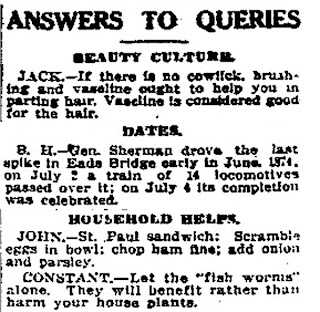
And from a 1916 column replying with answers to unprinted reader’s questions, “John” is told the ingredients for a “St. Paul sandwich: Scramble eggs in a bowl; chop ham fine; add onion and parsley.”
It was at the 1904 Worlds Fair in St. Louis that so many exhibitions tried very hard to show off new inventions and recipes and at least four versions of the Club Sandwich appeared there. This might have been the debut of the American sandwich formula of “meat + Mayonnaise + lettuce + tomato.”

So the history of the St. Paul sandwich has been an established St. Louis restaurant item now for at least one hundred years. It seems very likely that the various Asian, African and European immigrants in the densely populated city was the unique combination of factors that contributed to the creation of the Americanized Egg Foo Yung sandwich with the Catholic name - the Saint Louis Saint Paul.

Wednesday, September 14, 2011

A beautiful coffee-table book with original illustrations, vintage advertising and rare photographs detailing the chronological story of what the St. Louis blues are, who the St. Louis blues musicians were, and how their careers began in St. Louis.
Included with the book is a special compact disc of recordings by St Louis legends from Delmark Records. Devil At The Confluence is the only comprehensive book ever published on the history of the blues music of St. Louis.

Devil At The Confluence, The PreWar Blues Of St. Louis, Missouri is available at the St. Louis independent bookstores
Left Bank Books (Central West End and Downtown),
The Illustrated Art Museum in Crestwood Artspace,
Subterranean Books (University City),
The Archive on Cherokee Street,

Information and news is also posted on Facebook. Be a friend of the Devil: