Showing posts with label St Louis. Show all posts

Thursday, September 29, 2011

The St Louis St Paul.

The book, Devil At The Confluence, concerns the incredible stories of over a hundred important musicians from St. Louis who had never been profiled before. Although these musicians were neglected in music history they represent important claims of St. Louis contributions to American culture. And like the recorded blues of St. Louis, the local foods have never really been investigated either. There are the famous local inventions of Iced Tea, Ice Cream, Toasted Ravioli and Gooey Butter Cake, but this essay is an attempt to end speculation with facts concerning the rarely honored St. Paul sandwich. Because just like St. Louis music, other historically important cultural inventions from St Louis have been neglected and ignored for too long.

These new facts about the St. Paul were stumbled upon while researching for the book. It’s bothersome that many St. Louis historical facts and artifacts have been appropriated by other areas and even more bothersome that it seems that the facts were conceded without argument. Some of these claims may seem unimportant such as the creation of Planters Punch or the Tom Collins cocktails, while others are nationally significant cultural traditions such as beer and hotdogs at baseball games. And somewhere in that wide span of cultural importance falls the St. Paul sandwich.


Wiki (and please, kids never, ever confuse Wikis for real research) states that:

The St. Paul Sandwich is a type of sandwich found in Chinese restaurants in St. Louis. The sandwich consists of an egg foo young patty served with lettuce, pickle slices, mayonnaise and tomatoes between two slices of soft commercial white bread, such as Wonder Bread.”

But Wiki is not the place to look for missing answers to unsolved mysteries. The crowd-sourced and unverified soft-database says:

The origin of the sandwich is unclear

followed by this Wiki-wishy-washiness:

It was invented in St. Louis, Missouri and is usually only available in Chinese restaurants in the St. Louis metropolitan area.


The St. Louis St. Paul sandwich was featured in a 2002 PBS documentary called Sandwiches That You Will Like but the question of the history of the item was answered with a shrug. In the companion book of the documentary, American Sandwich: Great Eats From All 50 States.” it says that sources (unnamed) claim that the sandwich dates as far back as the 1960s and another source (unnamed) says the early 1940s.


So no one knows the history about the sandwich, yet the sandwich can only be found in St. Louis? Well that’s enough to claim it as a local invention. Really, if this was Chicago that would be enough and it would be up to somebody else to try and prove that it wasn’t. In fact, that’s the way it is for nearly every historical claim to American foods like hot dogs, pizza or pretzels. There just isn’t a lot of documentation on this kinda stuff, so being the only place that has it means it comes from there. This shouldn’t be a mystery.

Or could it be that St. Louis doesn’t want to claim it? Like the gooey butter and fried brains crowd draws a line in the saturated fat and refuses the St. Paul? Or maybe it’s like St. Louis’ unclaimed rights to American music history, a victim of that local inferiority-complex thing - a belief that new or important creativity must have come from somewhere else.

Or maybe it’s not as bad as all that. In the last few years there seems to be a change for the better in St. Louis. There is a new local pride. And the St. Paul sandwich has benefited from it.

In 2009, after Playboy magazine listed the St. Paul Sandwich as one of its top ten sandwiches, but noted that the sandwich might not have St. Louis roots, Joe Bonwich defended the city’s claim in his comments in STLToday:

This is a one-source legend dating to a 2006 article by Malcom Gay in the RFT, in which Park Chop Suey's owner claims that a former owner of the restaurant, who was from St. Paul, Minn., invented the thing. But there's no corroborating evidence, and the way it's worded, it sounds like the sandwich was invented in St. Paul and migrated here.

Thank you, Mr Bonwich!


Alone, the sandwich may not be as big of a tourism draw as perhaps the Cheesesteak is for Philly, but maybe it can be. Lunch Encounter, a blog by Washington, DC-based food writer Lisa Cherkasky apparently thinks so:

Just one more compelling reason to get your sandwich eating self to St Louis, the St Paul Sandwich.

Thank you Lisa, bring them in. And then she muses about the source of the dish by showing some impressive knowledge of local history:

I wonder, does it have anything to do with Chinese railroad workers? I would say, after doing a tiny bit of research, yes. In 2007 there were 700 Chinese restaurants in St Louis. That would point, one would reason, to a long history of Chinese-American culture. When you sit in Busch Stadium watching St. Louis Cardinals games, you may never imagine this location was once China Town. The first wave of Chinese came to St. Louis in 1869 when many of them lost their jobs as railroad construction workers. At the peak period, the Mid-Pacific Railroad Company hired over 10,000 Chinese laborers. When the westward railroad construction was completed, many became unemployed. Many of them chose to come to St. Louis that was then the 4th largest city in the United States.

St Louis' Chinatown was without firm and clear borders just like the many other immigrant areas of the city. The area of Busch Stadium at that same time was also known as Tamaletown, with a large number of Mexican immigrants. In Devil At The Confluence there is an early picture of the headquarters of African-American music, the Deluxe Music Shop and visible next door to it is Wo Hop Chop Suey. Different nationalities and races mixed block-by-block in the city at the turn of the century. And that fact about the confluence city is perhaps most significant to the cultural invention of the St Paul sandwich as noted by none other than frontman for the local alt-country/roots rock band, the Bottle Rockets, Brian Henneman.

I wouldn't be one bit surprised to find out the St. Paul sandwich originated from the cross pollination of African American culture, and the plethora of local Chinese restaurants.

And there it is. There is the significant uniqueness of St Louis' cultural history - the merging of styles in a location suited for the creative blending. A common ground that isn't north or south, or east or west, or country or urban. There's a strand of the unifiying thread found across the cultural and creative aspects of the city of the confluence.


So here we add the evidence found during our research. The first image is a photograph from sometime around the turn of the century. Two men stand in front of a typical restaurant on a street in St. Louis, on the wall is posted the menu.

The second image shows the wall menu in the photograph enlarged and enhanced. The second item in the SANDWICHES column on the left reads: “Try our ST. PAUL


The next images are St. Louis Post-Dispatch newspaper articles. From 1922, the Man On The Sandbox editorial column reads: “Our idea of a civic short order lunch is a St. Paul sandwich on Milwaukee rye.”


From 1918, the Sport Salad column makes reference to a St. Paul sandwich, “which is composed principally of ham and eggs.”


Both of these St. Louis editorials are making esoteric comments on matters of the day that are not known so it’s hard to understand what exactly these comments mean, but they are surely joking about something.

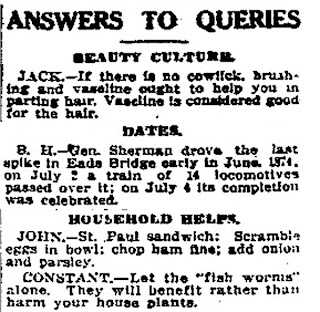
And from a 1916 column replying with answers to unprinted reader’s questions, “John” is told the ingredients for a “St. Paul sandwich: Scramble eggs in a bowl; chop ham fine; add onion and parsley.”
It was at the 1904 Worlds Fair in St. Louis that so many exhibitions tried very hard to show off new inventions and recipes and at least four versions of the Club Sandwich appeared there. This might have been the debut of the American sandwich formula of “meat + Mayonnaise + lettuce + tomato.”

So the history of the St. Paul sandwich has been an established St. Louis restaurant item now for at least one hundred years. It seems very likely that the various Asian, African and European immigrants in the densely populated city was the unique combination of factors that contributed to the creation of the Americanized Egg Foo Yung sandwich with the Catholic name - the Saint Louis Saint Paul.

Wednesday, August 17, 2011

The Palladium and the Marathon craze


A marathon dance in 1910 in St Louis ended when it was called a draw and three prizes were awarded to three couples. As organizer of the benefit, Annie Jackson made the call. She was worried that the police would interfere if the marathon became too strenuous on the couples. Already that summer, marathons had been raided by police in San Francisco and Brooklyn and Annie didn't want any such trouble at her event. Also, the public attendance for the week had been exceptional so she could easily afford to pay each couple the $25 prize. That wasn't how the marathon dances craze of the later Jazz Age usually went. Typically, these things were 24/7, no-mercy, last-man-standing kind of endurance contests. The same themes of reality TV like Survivor, Idol and Dancing with the Stars, the dance marathon was the beginning of the stuff of American pop culture. Horace McCoy's book, They Shoot Horses, Don't They? was made into a movie in the 1970s and it portrays the character, the hype and the seedy scenes of the marathon spectacle very vividly.

The Palladium building off Grand at Delmar and Enright was built as a Roller Skating rink in 1914 and a newspaper article told of Gene Rodemich's early St Louis Jazz band performing there. Music was changing from the Ragtime fad to the Jazz fad and the spectator sport of Roller Derby was evolving around the Rollerskating fad. On these roller skating rinks, the Marathon Dance Derby or "Walkathon" fad began.


Reliable information available about the Marathon craze is scarce and most of what is available assumes that it occurred only during the depression. But it was in at least two other cities besides St. Louis by 1910 and the last one in St. Louis was held at the end of the 1930s.

By 1950, the Club Plantation had seen it's best days. The club's old crowd had settled down to make baby-boom babies and didn't come out much anymore. The new younger crowd with their new music were making some new place crowded, like the beatniks over in the Gaslight Square area or the lounge crooners at the Chase Hotel.

Historically, St. Louis culture has a unique creative technique in finding the future trends - it takes the best of the past and brings it forward. So it doesn't seem strange that the Club Plantation's owner, Tony Scarpelli, had an idea to bring back some business to his place by bringing back the Marathon. He ran an ad in the entertainment trade journals for a revival of an authentic old-time Walkathon Derby in the authentic, historic Palladium building.


It's not known if his Walkathon revival ever happened. Shortly thereafter the Club Plantation was gone and Tony had gone into other business. But maybe years later, he saw the movie They Shoot Horses, Don't They?

And maybe years later, Tony saw the end of the 1970s when the younger crowd and their new music called Disco were dancing on Rollerskates in Roller Rinks.

Thursday, September 2, 2010

Devil At The Confluence uncovers a forgotten era" Living St. Louis, KETC

"Silvercloud's style and repertoire was in keeping with an older generation of St Louis blues artists whose names and achievements were largely forgotten."
Ruth Ezell.
From "Devil At The Confluence uncovers a forgotten era" Living St. Louis, KETC, airs Sept - Dec 2010.

Devil At The Confluence uncovers a forgotten era" Living St. Louis, KETC


The Devil At The Confluence exhibit at the Illustrated Art Museum in the ArtSpace at Crestwood Court. 37 Crestwood Court, Crestwood, MO, 314-941-2097.
From "Devil At The Confluence uncovers a forgotten era" Living St. Louis, KETC, airs Sept - Dec 2010.

Devil At The Confluence uncovers a forgotten era" Living St. Louis, KETC

"I came up in the punk rock scene and quickly discovered blues. Not only was I interested in their playing, but the actual content of the songs. [The Rum Drum Ramblers,] everything we record is all originals - our take on that music, but it's new. That's our way of carrying it forward."
Mat Wilson.
From "Devil At The Confluence uncovers a forgotten era" Living St. Louis, KETC, airs Sept - Dec 2010.

Devil At The Confluence uncovers a forgotten era" Living St. Louis, KETC

"St Louis superstar artists were recording through the Depression, when 75 cents was a lot for someone to spend for a record and bringing an artist in to record them and make a record and market it cost the companies a lot of money. During the Depression they didn't do that with just anyone and St Louis artists were recording through the Depression decade like there was no Depression. That says a lot about the talent in St Louis."
Kevin Belford.
From "Devil At The Confluence uncovers a forgotten era" Living St. Louis, KETC, airs Sept - Dec 2010.

Devil At The Confluence uncovers a forgotten era" Living St. Louis, KETC

"There were blues clubs all over the city. All the way out to the city limits and even to the county - Northside, Southside, Midtown... it was like a circuit in itself."
Bernie Hayes.
From "Devil At The Confluence uncovers a forgotten era" Living St. Louis, KETC, airs Sept - Dec 2010.

Devil At The Confluence uncovers a forgotten era" Living St. Louis, KETC

"I went looking for the names and the biographies of St Louis blues musicians and started looking at the traditional books on the blues, They are all about the guys in the Delta, Memphis or Chicago. It's like,"Well where's St Louis?" There's a paragraph here and there. No list of names, no biographies and everyone knows St Louis had a really strong tradition of blues."
Kevin Belford.
From "Devil At The Confluence uncovers a forgotten era" Living St. Louis, KETC, airs Sept - Dec 2010.

Devil At The Confluence uncovers a forgotten era" Living St. Louis, KETC


"St Louis has been a major influence in the evolution of several forms of music, not the least of which is the blues. But few among us knew the extent of that influence until a forgotten chapter in the history of the St Louis blues was rediscovered."
From "Devil At The Confluence uncovers a forgotten era" Living St. Louis, KETC, airs Sept - Dec 2010.

Tuesday, August 31, 2010

Lonnie Johnson and the Confluence Blues continued.

Lonnie Johnson and Sylvester Weaver are the men who pioneered blues guitar in the earliest years and both were doing it beyond the Delta of the Mississippi river and the Gulf of Mexico. Their recordings demonstrated what the guitar could do and they were decades ahead of their time. Lonnie's music was the birth of the blues writer/singer/guitarist. His sensational guitar work rose out from a period when the piano blues and the great female voices were replacing ragtime and marching band music.

Lonnie developed his guitar and violin style and blues sensibility in St Louis, and eventually he got his opportunity to make records because of the St Louis audiences. It was in the Booker Washington theater in St Louis where Lonnie made his musical home and it was the audience of the city who discovered and appreciated his music and awarded him winner of the weekly blues contest for many months in a row - virtually forcing Okeh records to realize that there was a market for this new music. The St Louis environment and the St Louis audience appreciation and support are the important parts of this story. These elements are the crucial part of his meteoric rise to stardom. And the city was more important to him and his music than any other place he resided in. 

He made his first recordings in St Louis, he and his brother married and raised families in St Louis, the largest part of his career was in St Louis and all of the close-knit musicians of the community in St Louis were his friends and partners in recordings.

Both St Louis and Lonnie Johnson are generally under-recognized in the commonly known history of American blues music. Lonnie's story illustrates this best, but there are many more St Louis legends revealed for the first time in Devil At The Confluence.

Monday, August 23, 2010

Jay Farrar - History at the Old Rock House.


On June 17, 2010, at his sold-out show, local Alt-country legend Jay Farrar gave a short talk about Devil At The Confluence before playing his song Outside The Door from his album, Sebastopol. The song's lyrics include a number of historical St Louis blues music names and places and Jay realizes that the long proud tradition of St Louis' strong musical heritage is sadly under-recognized. Devil At The Confluence hopes to change that and welcomes Jay along with many of the city's other talented current artists to the cause. We spoke with Jay not long ago and that and other interviews will be posted. More to come on the local artists that continue the St Louis Confluence tradition soon.

Image from the Riverfront Times blog.

Wednesday, August 11, 2010

This is a quick post repeating the three very important points in the last post.

1. The musicians in Devil At The Confluence are all St Louisans.  
Lonnie, his wife Mary, Edith Johnson, Moore, Wheatstraw, Williams, Davis, Sykes, Jordan, Gibson, Townsend and all of the rest were not migrating. They lived in St Louis.
Others like Kokomo Arnold, Yank Rachel or Leroy Carr were not migrating, but they visited often or lived in St Louis. And it could be argued that they were a part of the St Louis community of musicians, but to stay strictly to those that recorded in St Louis, they aren't profiled in Devil At The Confluence. After WWII there was a lot of travel and relocating and possibly that's where the idea of St Louis, located in the middle of the country on Route 66, was a place to visit or pass through. 

2. The Southern birth theory of blues music history is inaccurate. 
W C Handy and Rainey first heard the music they called blues in St Louis while ragtime was still big and Joplin had a new hit with The Entertainer. Easily before Son House was born and even before Mississippi John Hurt was born.

3. In Devil At The Confluence, the definition of what is "blues" is based on what the pre-war artist's themselves said and what they called blues. Not what record companies, authors, critics or fans decided. 

The next post will continue with the most asked questions and more on Lonnie Johnson.

Monday, August 9, 2010

The real St Louis' Blues.

It seems like there hasn't been a break since Devil At The Confluence hit the bookshelves. Nearly weekly events, exhibits, readings and discussions have been going on for many months now and it's been very exciting to see this wave of enthusiasm and interest in the subject of St Louis history. It's very interesting and encouraging because there is a real thirst and enthusiasm for the stories of the decades of lost St Louis musical history. I've kept notes of the questions that I get most often and I'm going to try to elaborate on them here at the blog.

The first point of the book and the biggest misperception about the city's blues music history is also the most often discussed. And that is the fact that the book contains biographies of only musicians who are St Louisans. 
They are not visitors to St Louis or migrating southerners. 

The idea that music was solely formed and developed in the Delta and carried by one man or maybe a few from the Delta to be played for and taught directly to others in northern areas is probably the biggest misconception of American music history. 

The artists depicted with their biographies in Devil At The Confluence lived in St Louis, had families in St Louis or nearby, first recorded from St Louis and there is no evidence of music before they recorded in St Louis. This seems like an odd point to repeat about a book subtitled "The Pre-war Blues Music Of St Louis, Missouri," but it is the most important because the mythology that developed about blues music and it's evolution is a very prevalent and commonly accepted theory. It's outdated and inaccurate and it has diminished St Louis' importance to American music history. It was the realization of St Louis' many many blues greats and musical contributions that revealed this error and compelled me to make the book.

St Louis Bluesman Lonnie Johnson is a perfect example to illustrate the misunderstanding of early blues history. His music was blues. 
"Blues" is the word that he used for his music. 
And the original audience and buyers of the music called it "blues." 
And his contemporaries, the original legendary innovators of the music, used the word "blues" to describe the music. 
And that is the definition of "blues" that I used in the book. You'll see why that's an important point when talking about St Louis and Lonnie Johnson.

The next blog post will be Lonnie Johnson's story and why he and his city were overlooked in blues history.

Wednesday, December 2, 2009

The research behind the book


  When I began researching the St Louis blues music I found that most of the city's pre-war musicians were not included in the many books and discussions of the music. I also found that the few St Louis artists who were mentioned in blues writings were often described as Mississippi or delta area musicians. This was often done to give the artist some "blues credibility" since the blues are often mistaken as a solely Southern type of music. But I was amazed when I found Henry Townsend described as a delta artist, (Last of the Great Mississippi Delta Bluesmen, Henry Townsend, and "Townsend is one of the few living pre-war acoustic delta blues artists." )

  Henry was born in Shelby, Mississippi and carried by his father as an infant to Cairo, Illinois. Living there with his family until his young teens, he ran away from home to St Louis, Missouri and remained in St Louis the rest of his life. It was in St Louis that Henry saw Lonnie Johnson performing the blues at the Booker Washington Theater. Johnson on stage in a nice suit and playing his smooth sophisticated blues on guitar was what made Henry want to be a musician. Henry learned guitar and picked up the music from other musicians in St Louis, eventually becoming one of the more popular accompanists in the city. But, other than spending a few months in Chicago in the 1930s, Henry lived in St Louis for  all of his life.

  Finding this kind of distortion in the biographies of St Louis musicians made me suspicious of the rest of the information available for the blues of St Louis. I decided to test all the available facts that I could find concerning the music and artists of the city against primary source information such as interviews, city records, census, etc..

  Nearly all of the information in Devil At The Confluence on the hundreds of names that I found who had recorded from St Louis in the pre-war blues period is new and unpublished information.

  Recently I received an email from a music library cataloger at a large University. He was entering the information from the Devil At The Confluence CD included with the book into the library catalog and found discrepancies with the information in the book on Mary Johnson and the official information for her in the Library of Congress records. He listed the birth and death dates and the maiden name of "Smith" and the brief biographical details that are on record for Mary Johnson (".. two 'authority records,' part of an electronic database maintained at the Library of Congress; catalogers use the database to store and retrieve standardized 'headings' for people, corporate bodies, and titles of works") and asked me about my sources that I used to assign my birth and death dates and maiden name since it differs from the database.

  I replied that, in researching the information on the blues musicians of St Louis, I used a variety of sources and compiled them as best that I could. The sources that are quoted in his email were considered by me along with information about those sources and new information that I discovered. 

  Generally, the "official" recorded details of Mary Johnson's life were gathered by Paul Oliver when he contacted Bob Koester and visited St Louis sometime prior to 1960. Oliver had, I believe, only one interview session with Mary and her mother Emma. Koester and the St Louis Jazz Club had a meeting where Mary performed in 1955 and she was interviewed by Charlie O'Brien and Koester and possibly other members of the Jazz Club - although no notes or recordings of those interviews could be found. I believe that the information gathered from O'Brien and club members was passed on to others including possibly Sheldon Harris and Guido Van Rijn. I assume this type of informal discussion is how the published Mary Johnson facts came to be recognized, because the details of Mary Johnson's life are not well footnoted and the authors of the published books had only Oliver, Koester or O'Brien's verbal accounts to go by. Later books and websites mostly only re-wrote the scant details that were published by Paul Oliver.

  After Koester moved to Chicago, O'Brien gathered information for Van Rijn and they corresponded by mail. Additionally, Sam Charters of Folkways Records recorded Mary and Henry Brown in St Louis in 1961 and Mr. Charters often interviewed his subjects.

  The liner notes to Agram Records' "Mary Johnson - I Can't Take It" (Guido Van Rijn, Amsterdam, c 1988) states that: "Mary told Paul Oliver in 1960 that her mother Emma, was born in Eden Station, MS." and "Emma married a man named Smith and they had a daughter, Mary in 1905 near Jackson MS." (sourced by Van Rijn to: Oliver, Paul; "Interview with Emma Williams", St Louis, Aug 25, 1960. Van Rijn claims access to Oliver's notes from 1960 containing information that Oliver had not used in his book, "Conversation With The Blues" although the interview notes are not published.)

  And the book, "Blues Who's Who," contains the following information: "...born Mary Smith, an only child." No death date given. (Harris, Sheldon; BLUES WHO'S WHO, p. 288, Arlington House, NY, 1979.)

  These details are published without verifiable sources and I know of no confirmation of this information. Also, I disregarded unsourced web posted information. 

  My new research includes the following:

  From the Gould's City Directories (Missouri History Museum Library & Research Center and St Louis County Library Headquarters branch, Special Collections Department):
In 1960, there is a listing for: JOHNSON, Mary, Mrs, (r) 1311A Biddle.
From 1961 to 1970 Mary and Emma lived on Carr Ave.
From 1971 to 1980 Mary lived alone on Carr, and the last listing for Mary was in 1983.

  I was not able to find a birth, death or marriage certificate for Mary Johnson because I was told that in order to acquire these documents that I needed to prove a relationship to the individual at the City of St Louis Recorder of Deeds, Vital Records department.

  In the Greenwood Cemetery records that I had discovered and deposited at Western Historical Manuscripts at UMSL, I found two burials but I could not verify that these were the Mary Johnson and Emma Williams in question:

MARY JOHNSON d. 7/20/1983

EMMA WILLIAMS d.11/17/69

  The web-based Social Security Death Index lists one St Louis Mary Johnson in 1983 and two in 1984:

MARY JOHNSON 29 Mar 1898 Jul 1983 63115 (Saint Louis, MO)

MARY JOHNSON 31 Oct 1901 Apr 1984 63133 (Saint Louis, MO)

MARY JOHNSON 21 Aug 1889 Dec 1984 63121 (Saint Louis, MO)

  And the only Emma Williams listed from 1968 - 1974 is:

EMMA WILLIAMS 18 May 1880 Dec 1969 63106 (Saint Louis, MO)

  These details seem to indicate that:

  Emma Williams and a man named Smith had a daughter named Mary. (Whether Emma had the surname Smith at any time is not clear. The instances of the surname Williams for Mary Johnson seem to be from writer's assumptions that Emma's last name must be Mary's maiden name.)

  The reported birthdates include; 1900, c 1900, and 1905. (The 1905 birth date is apparently sourced from Van Rijn via Oliver's unpublished notes.)

  The reported birth locations vary; "Yazoo City," "near Yazoo City," "Yazoo County," "Eden Station, MS.,"  and "near Jackson, MS."

  Emma and Mary were in St Louis.

  Recording artist Lonnie Johnson married Mary (likely Smith) and she became Mary Johnson (around 1925.)

  Koester and O'Brien found Mary Johnson, former wife of Lonnie Johnson, in St Louis in the mid 1950s.

  Mary Johnson and Emma Williams lived together in St Louis in the 1960s.

  Emma Williams is not listed in the Gould's City directories with Mary Johnson after 1970.

  Reported death dates for Mary Johnson are "alive in 1970" and "1970?".

  Mary Johnson is not listed in the Gould's City directories after 1983.

  The Gould's directories are certainly the listings for the Mary (ending in 1983) and Emma (ending in 1969) in question.
  The Social Security Index identifies a Mary Johnson in St Louis and in a probable Zip Code who died in 1983, and an Emma Williams who died in 1969.
  And the Greenwood Cemetery records both contain a Mary Johnson who died in 1983 and an Emma Williams who died in 1969.

  I strongly feel that these records are for Mary Johnson and her mother, but I have no concrete verification (Health Department birth or death documents,) so my conclusion was that an approximate and likely date of birth would be 1900 (1898 - 1905, accounting for the various reports even though I strongly believe that her birth was 1898) and a death date of 1983. 

  This is the type of research that went into the making of Devil At The Confluence. I hope to donate my research files to a number of universities so that this information can be available for researchers and writers. I believe that when the facts for the rest of the hundreds of St Louis Pre-war blues musicians are established and recorded in the Library of Congress database, that it will be obvious that the city of St. Louis was a dominant force in the creation of American popular music and culture. This new information of such a large number of Pre-war artists from St Louis, likely the most of any one area of the United States, compels us to rethink the traditional theory of the story of American music.

Tuesday, December 1, 2009

Booksignings, recent press and reader's comments.

Booksignings:

Thursday, December 3, 7pm, Subterranean Books signing with Kevin Belford for Devil at the Confluence @ Subterranean, 6275 Delmar, U. City, free.

Sunday, December 6, 2009, 1-3 pm
Kevin Belford, Jeff Fister and Dr. John Oldani at the "Book Jamboree" at the St. Louis Genealogical Society in Sunnen Industrial Park, #4 Sunnen Drive, St. Louis, MO 63143.
St. Louis area history and locally-themed books, local authors, free and open to the public.


What others are saying about Devil at the Confluence: 

"The best examples of the music's unvarnished power."
- USAtoday

"Making the case that St. Louis brought together a mix of country and city musicians, resulting in significant contributions to the genre."
- MSNBC

"Provides a serious challenge to the long-held theory that the blues developed from a single point of origin."
- Terry Perkins, St Louis Post-Dispatch.

"Belford illustrated and wrote his book by scouring old record collections and newspaper clippings, scrutinizing past city maps and talking to just about anyone who knew about the local blues."
- Los Angeles Times.

"Packed with fascinating facts, cool artifacts, secret backstories, and gorgeous art."
- Adsaint

"Likely to surprise even so-called experts."
- The St. Louis Beacon.

"The untold history of the founding musicians of the St. Louis blues movement and an abundance of historical information."
- The Webster Kirkwood Times.

Rick Merry - I love the book !!!

Peter Cohen - Folks this is an awesome book, perfectly detailed and illustrated.

Vinnie Valenza - This book is a treasure! Everybody in this town and beyond need to read this book!

Devil At The Confluence is available at all major bookstores, Borders, Barnes & Noble and through Amazon. Signed copies can be requested by emailing devilattheconfluence (at) gmail.com.

Saturday, June 27, 2009

Lonnie Johnson


Lonnie Johnson can be seen as the epitome of the St. Louis blues. 

With so much creativity and skills so far advanced of his time, the brilliance of Lonnie Johnson stands alone and often uncategorized in typical blues history writings. The blues purist authors avoid Johnson's amazing guitar dexterity that makes nearly all other pre-war guitar work seem primitive, and the jazz music history writers cold-shoulder him because he was not working from arrangement sheets.

The prolific careers of so many musicians in the St. Louis area in the 1920s and 30s and the innovative art they created defined the blues as more than only rough rural guitar from the southern United States. And like Lonnie Johnson, they made their art and advanced the field of music by inspiring other blues artists to keep up with the avant-garde from the city of the confluence. They made their own category of blues from what came before it and defined what was to come after it, but the St Louis blues have not yet been recognized as its own category, primarily because of the progressive concepts and the variety of the music from the many artists from the city.